


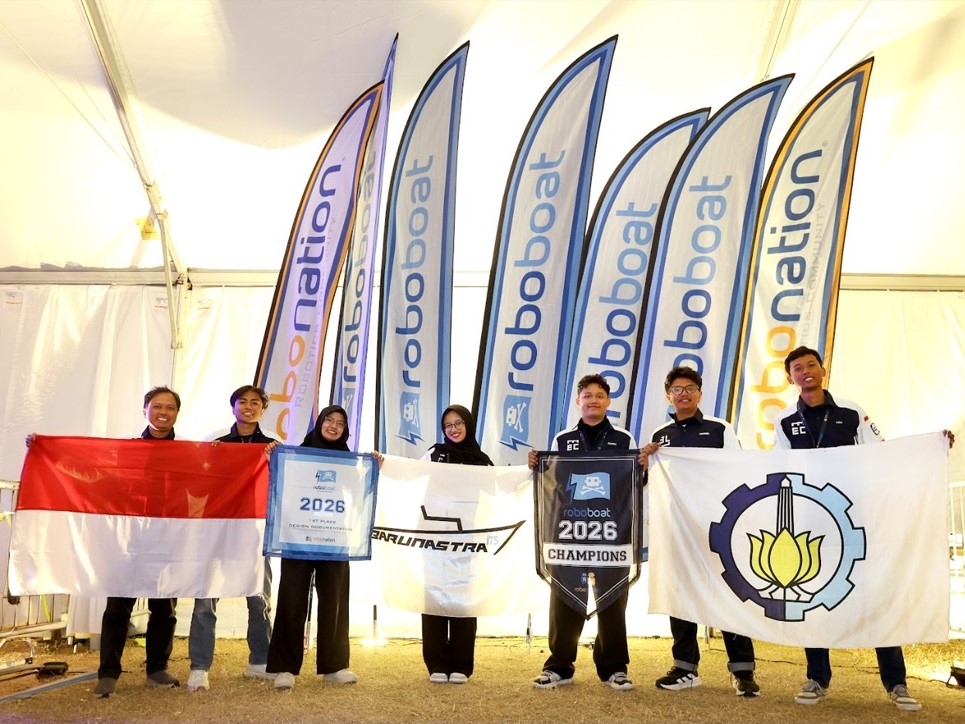
BARUNASTRA ITS SHINES AS GRAND CHAMPION AT THE INTERNATIONAL ROBOBOAT COMPETITION 2026 WITH INNOVATIVE TECHNOLOGY
An Indonesian student-built autonomous vessel showcases advanced technology while outperforming leading global university teams
Indonesia has once again achieved a proud milestone on the international stage through technological innovation developed by its students. The Barunastra team from Institut Teknologi Sepuluh Nopember (ITS) successfully secured the Grand Champion title at the International RoboBoat Competition 2026, held at Nathan Benderson Park, Florida, United States, from February 19 to 24, 2026.
This prestigious competition brought together 36 teams from 10 countries, including leading technology universities such as Massachusetts Institute of Technology (MIT), Queen’s University, and Georgia Institute of Technology. Amid strong global competition, the Barunastra ITS team stood out with its autonomous vessel, Nala Ares Mark II. The vessel successfully won two major categories, Autonomy Challenge and Design and Documentation. The team also received the Best Technical Design Report award for its comprehensive and well prepared technical documentation.
The International RoboBoat Competition focuses on the development of Autonomous Surface Vehicles (ASV), which are unmanned vessels designed to navigate and perform missions independently. The technology integrates sensors, navigation systems, vessel control programming, and artificial intelligence algorithms, allowing the vessel to operate autonomously in open water environments.
In this year’s Autonomy Challenge category, the competition adopted the theme Storm Response Technology in Action for Recovery and Relief. The theme simulated a harbor environment affected by disaster, where autonomous vessels were tested in various scenarios that required precise navigation, rapid response, and independent decision making.
During the challenge, the vessel had to complete a series of missions designed to represent emergency situations. One of the tasks, Evacuation Route and Return, tested the vessel’s ability to navigate through designated evacuation paths. Debris Clearance required the system to scan the area, detect survivors, and avoid dangerous objects among scattered debris. Another task, Emergency Response Sprint, required the vessel to move quickly according to visual markers.
Additional missions included Supply Drop, which required the vessel to deliver logistics with high precision, and Navigate the Marina, where the vessel had to locate a safe docking area and perform autonomous docking. The Harbor Alert mission tested the vessel’s ability to respond to sound based emergency signals that required the system to halt its mission and move to a designated zone.
These missions required the vessel’s system to interpret environmental conditions, make quick decisions, and maintain stable performance under constantly changing circumstances. The testing demonstrates the potential real world applications of autonomous vessel technology, including disaster response, maritime security patrols, and search and rescue operations.
The success of Barunastra ITS was made possible through interdisciplinary collaboration involving students from various departments within the university. The competing delegation included students from Engineering Physics, Electrical Engineering, Telecommunications Engineering, Informatics Engineering, Naval Systems Engineering, and Naval Architecture.
The vessel’s development was also supported by team members from Civil Engineering, Computer Engineering, Electrical Automation Engineering, Mechanical Engineering, Marine Transportation Engineering, and Information Systems.
This collaboration across multiple academic fields formed a strong foundation for designing and developing an autonomous vessel capable of competing at the global level. The achievement highlights the ability of Indonesian students to develop technological innovations that can compete alongside leading technology institutions around the world.
photo source: instagram.com/barunastra_its and instagram.com/socialfeed_id
#Barunastra ITS #International RoboBoat Competition 2026 #Grand Champion RoboBoat 2026 #autonomous vessel technology #Autonomous Surface Vehicle ASV #student built autonomous vessel #Nala Ares Mark II #Autonomy Challenge RoboBoat #Design and Documentation category #Best Technical Design Report #maritime robotics competition #artificial intelligence vessel navigation #autonomous boat innovation #robotics engineering students #maritime technology innovation #disaster response autonomous vessel #search and rescue autonomous vessel #global university robotics competition #ITS Barunastra team #unmanned surface vessel technology #media #article #rsvp clique
