


INTERESTING! INDONESIA EMERGES AS THE WORLD’S LARGEST COFFEE SHOP HUB BASED ON OPENSTREETMAP POI DATA
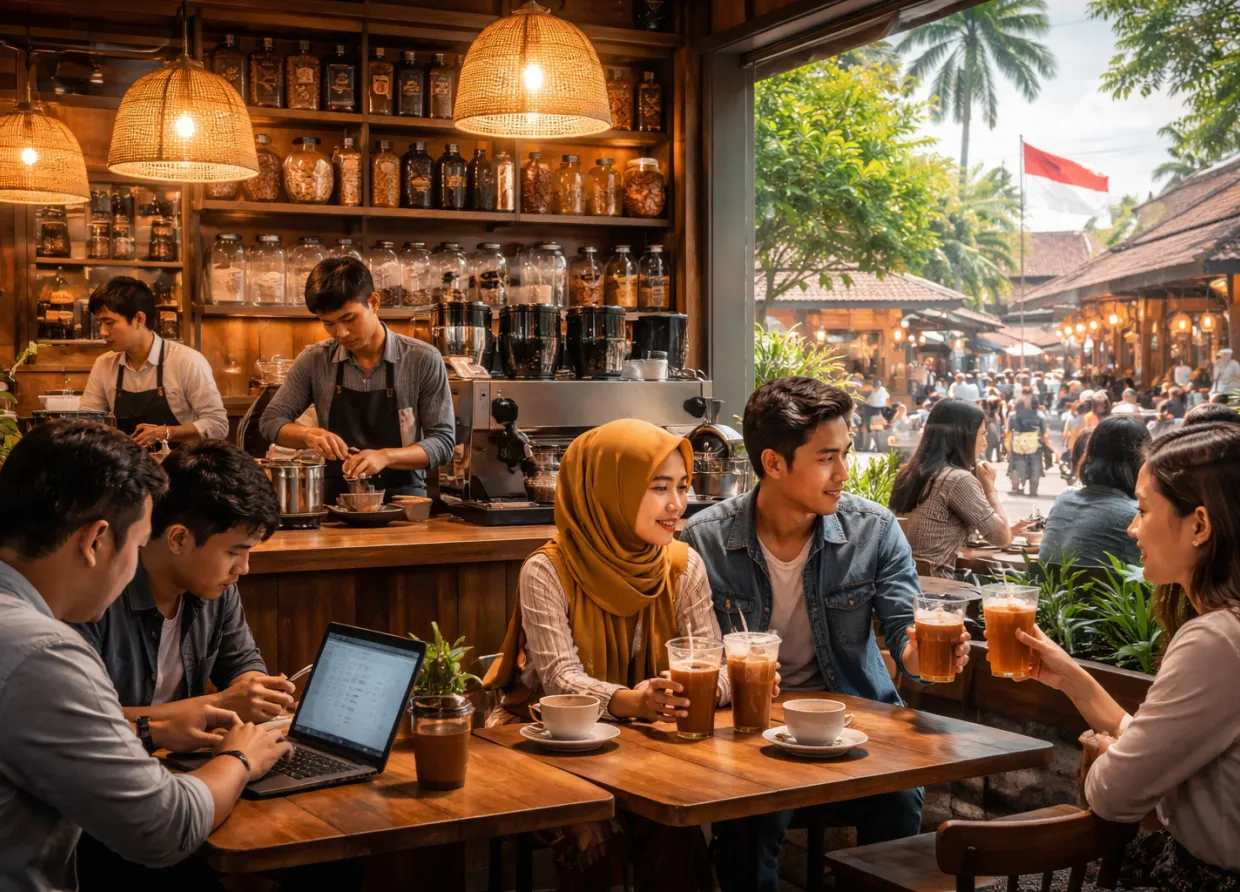
Coffee culture as a social space highlights how local traditions influence modern lifestyles
Indonesia has once again achieved a global milestone that often goes unnoticed. This time, it is not in sports, technology, or heavy industry, but in something deeply woven into everyday life: coffee. According to global Points of Interest data from OpenStreetMap, Indonesia is now officially recorded as the country with the highest number of coffee shops and cafés in the world.
As of November 2025, a total of 461,991 coffee-related business locations were recorded across the country. This impressive figure places Indonesia ahead of nations long known as global café culture icons, including the United States and China. It signals a major shift in the global coffee industry, one that has unfolded steadily and consistently over time.
A report published by seasia.co notes that the rapid growth of coffee shops in Indonesia cannot be attributed solely to caffeine consumption. The driving force lies in a deeply rooted cultural habit known as nongkrong, or social hanging out. In Indonesia, coffee shops serve as a third place, a space between home and work where social life naturally unfolds.
These spaces are used by freelancers working on laptops, small business owners meeting clients, students holding discussions, and local residents exchanging ideas on social and political issues. As a result, coffee shops are not confined to shopping malls or upscale districts. They thrive near university campuses, along residential alleys, and throughout local neighborhoods.
The nearly 462,000 coffee-related locations reflect a remarkably diverse ecosystem. Indonesia offers everything from traditional coffee stalls and grab-and-go kiosks to modern specialty cafés serving single origin beans. Minimalist cafés featuring Gayo, Toraja, Kintamani, or Flores coffee exist alongside long-standing coffee stalls that continue to offer affordable prices. As the world’s fourth-largest coffee producer, Indonesia is no longer focused solely on exports, but is increasingly celebrating its coffee within the domestic market.
Coffee shops also play an important role in introducing local flavors to consumers while encouraging younger generations to enter the industry. Farmers, roasters, baristas, and café owners are all part of this growing ecosystem. Coffee has become a bridge connecting agriculture, urban lifestyles, and entrepreneurship.
OpenStreetMap POI data, widely used for industry research and urban trend analysis, shows that this growth is further supported by digital technology and the evolution of traditional coffee stalls. Many warkop have adapted by offering WiFi, refreshing their interiors, and introducing manual brewing methods that appeal to a broader audience.
Below Indonesia, China ranks second with more than 190,000 locations, followed by the United States with 145,600, then Vietnam and South Korea. Behind every cup of coffee lies a story of culture, creativity, and local resilience. Without much global attention, Indonesia has quietly positioned itself as a new center of the global coffee industry, firmly rooted in tradition while confidently moving toward the future.
photo source: chatgpt.com
#Indonesia coffee shops #coffee culture in Indonesia #OpenStreetMap data #Points of Interest data #POI OpenStreetMap #café culture #third place #traditional coffee stalls #specialty cafés #single origin coffee #Gayo coffee #Toraja coffee #Kintamani coffee #Flores coffee #coffee industry #domestic market #digital technology #manual brewing methods #United States #China #media #article #rsvp clique #rc
