


INDONESIA RETURNS TO VENICE BIENNALE 2026 WITH 21 ETCHINGS
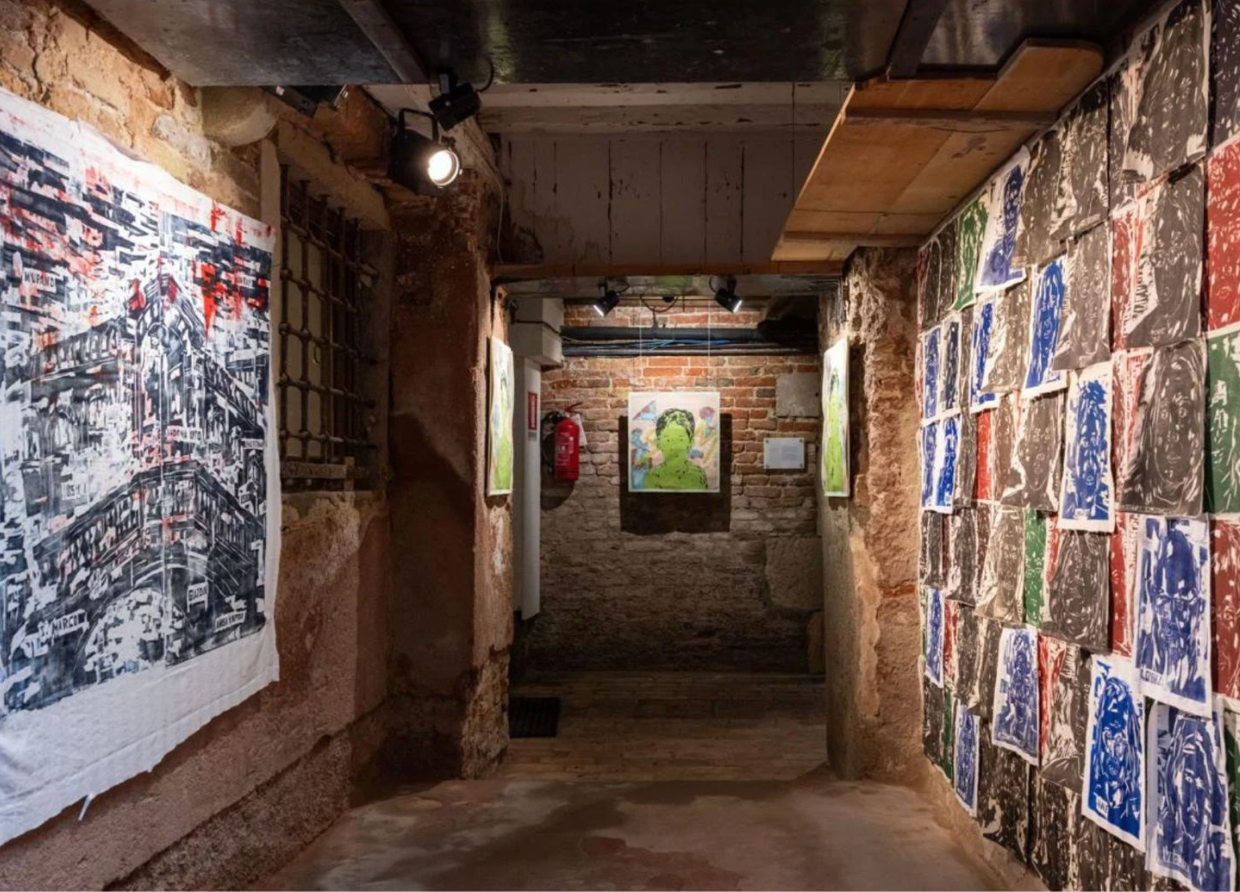
After six years away, Indonesia is back at Venice Biennale 2026 with Printing the Unprinted, 21 etchings across the walls of a Venetian printmaking school.
There is a school of printmaking on a quiet street in Venice that has been teaching graphic arts since the 16th century. Its walls have absorbed ink, copper dust, and the particular silence of artists working with their hands. On May 9, 2026, it became the Indonesian Pavilion.
Venice Biennale 2026 marks Indonesia's return to the world's oldest and most prestigious international art exhibition after a six-year absence. The last time Indonesia held a pavilion was in 2020. This time, it arrives with 14 artists, 21 etchings, and a fictional manuscript about a voyage that happened five centuries ago.
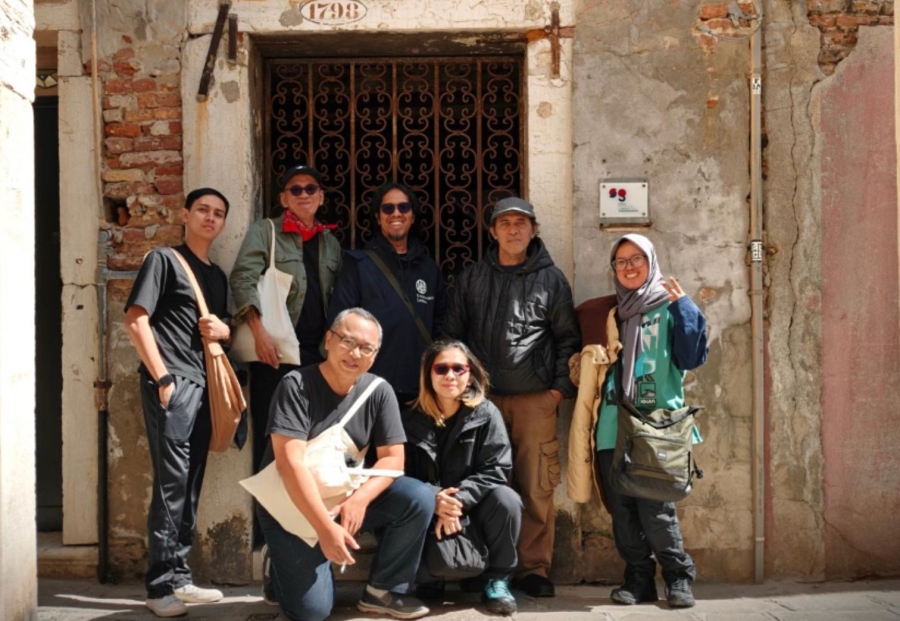
Printing Unprinted seven artists curator Venice Biennale 2026 Indonesia Scuola Grafica
What Printing the Unprinted Is and Why It Matters
The Indonesian Pavilion at Venice Biennale 2026 presents Printing the Unprinted, curated by Aminudin TH Siregar and produced through a collaboration between the Ministry of Culture and Scuola Internazionale di Grafica Venezia, with support from Danantara Indonesia Trust Fund.
At its heart, the project flips the familiar script of world discovery, casting a kingdom from the archipelago as the explorer who encounters the West. This shift transforms the notion of passive cultures, spotlighting Indonesia's vibrant contributions to maritime technology, commerce, the arts, and knowledge.
The story is told through the perspective of Datu Na Tolu Hamonangan, an imaginary archivist from the Kingdom of Pusuk Buhit in Sumatra, who documented a grand voyage spanning 14 years from 1472 to 1486. The fleet departed from Lake Toba, sailed through western Sumatra, Malacca, the Bay of Bengal, Gujarat, Hormuz, the Red Sea, and Alexandria before reaching Venice and Central Europe. Three ships made the journey: Siboru Deak Parujar as the flagship, Naga Padoha as the escort vessel, and Sahala ni Ombak dedicated entirely to scientific exploration.
The manuscript contains 21 etchings divided into eight chapters. Each chapter was assigned to a different artist, each one a different lens on the same voyage.
The Seven Artists and What Each Chapter Carries
The story sets sail with Agus Suwage, who frames the expedition's beginning through sacred authority and the art of diplomacy, the invisible architecture that makes any grand journey possible. R.E. Hartanto gives form to Admiral Mangiring, a seafarer who trained under Arab cartographers in Malacca and then led a crew of Batak navigators, Malay helmsmen, Tamil translators, and a Persian astronomer across open water, captured in three etchings: Departure Under the Southwest Monsoon Wind, Storm Off Hormuz, and The Aging Admiral's Face. Syahrizal Pahlevi takes on the role of the Navigator, producing Rewriting the Circle of the World, Library of Florence, and
The Inversion of the World Map, three works that flip geographic authority and ask whose version of the world has always been centered. Rusyan Yasin documents the voyage through a naturalist's eye, sketching unfamiliar plant life encountered near the Alps, and returning home with apple seedlings that were successfully cultivated in the Batak highlands, a small but lasting trace of cross-continental exchange.
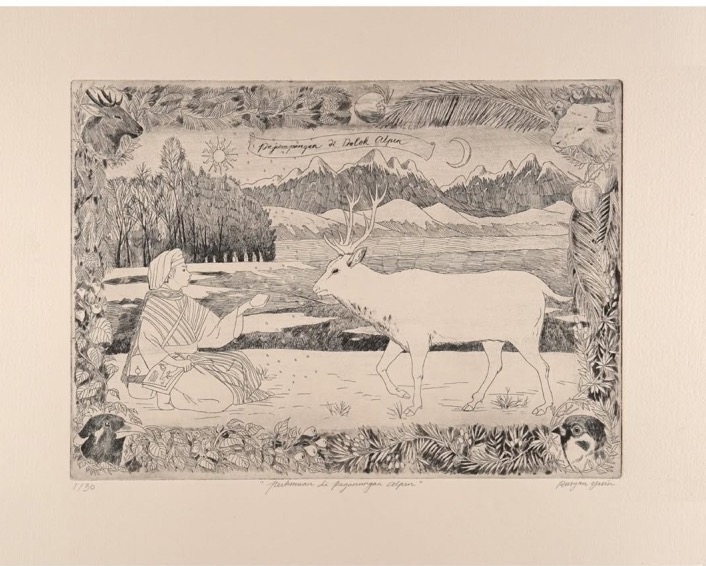
Rusyan Yasin's work at Paviliun Indonesia. Three etchings. One naturalist. Every specimen documented across two climates
The deeper the fleet travels, the richer the cultural entanglement becomes. Mariam Sofrina renders the human texture of these encounters in three etchings spanning Port of Malacca, Winter Market in Venice, and West Gorga, each one a snapshot of two worlds briefly sharing the same space. Nurdian Ichsan charts how technology and symbolism mutated through contact: Batak artisans who absorbed European glasswork, ceramic craft, and mechanical timekeeping eventually created a new royal seal that merged gorga ornamentation, Western heraldic tradition, and a Batak cosmological map into one unified form.
Closing the manuscript, Theresia Agustina Sitompul turns printmaking into a tool for excavation, using ordinary household objects to bring forward the unseen work of women and the weight of colonial inheritance that quietly shapes the present. Taken together, the seven artists refuse to let history remain a sealed document. Through ink, plate, and paper, they reopen it and write a different version in.
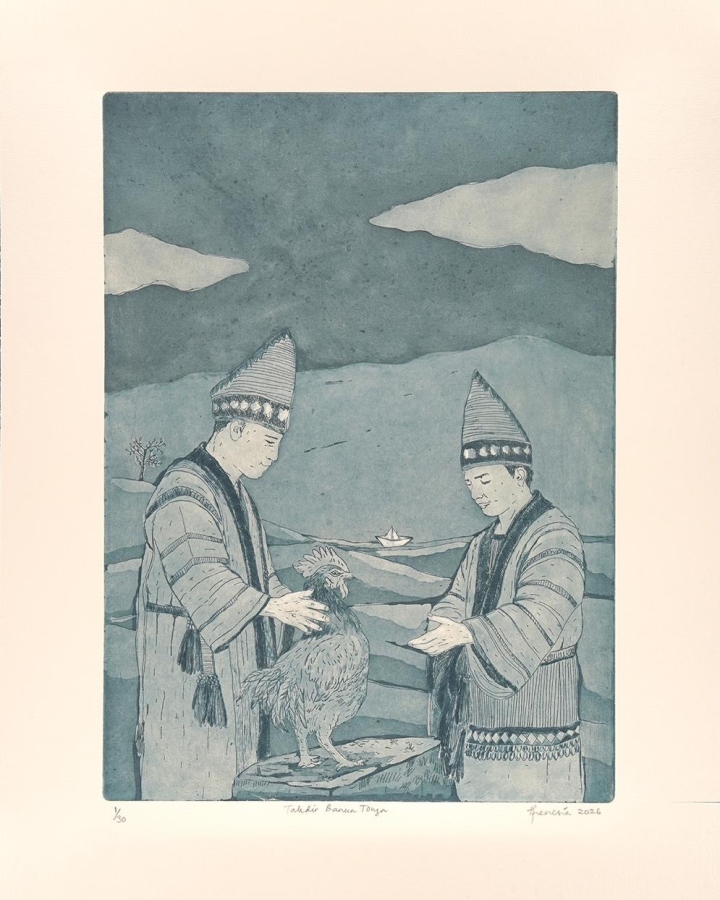
Theresia Agustina Sitompul closes the manuscript. The final sentence of the voyage: discovery is not ownership
Beyond the Seven: The Young Artists and the Opening
Indonesia's delegation in Venice Biennale 2026 totals 14 artists, combining the seven senior artists with seven young talents selected through the National Talent Management program of the Ministry of Culture, supported by Negeri Elok. The young artists come from across the archipelago, including regions affected by natural disasters in Aceh and North Sumatra, representatives from Papua, and artists with disabilities.
The seven young artists are Aniel Karoba, Valerio Vidigal Oki, Annisa Aqila, Eva Rosyadiatul Wardah, Muhammad Boy Farhan Sinaga, Muhammad Alfariz, and Rahmad Putra. Each collaborated directly with the senior artists during the residency at Scuola Internazionale di Grafica, working through an art therapy approach that placed creative practice as a space for processing memory, building empathy, and strengthening collective resilience.
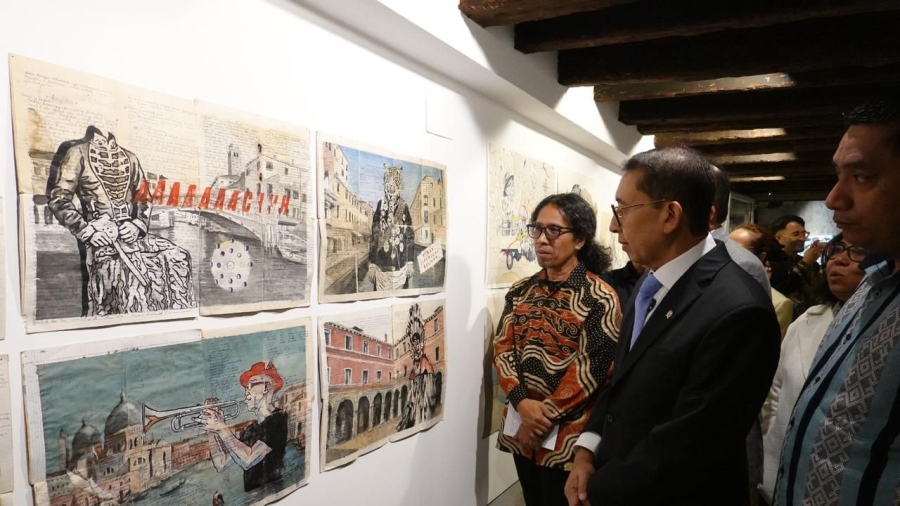
Minister of Culture Fadli Zon at the opening of Paviliun Indonesia. Culture, he said, is not just heritage. It is the foundation of the future.
Minister of Culture Fadli Zon attended the official opening on May 7, 2026. He stated that Indonesia arrived at Venice not merely to introduce its culture to the world, but to actively shape global conversation through art. "We believe culture is not merely heritage, but also the foundation for the future," he said.
Indonesia is also making its first appearance at the Venice Theatre Festival this year. Bumi Purnati Indonesia will present two theatre productions, Under the Volcano and Hikayat Perahu, at Teatro alle Tese in the Arsenale from June 16 to 17, 2026.
The pavilion runs until November 22, 2026. This is not a single appearance. It is a season.
For exhibition details, visit labiennale.org.
Related: Art Jakarta Garden 2026 : When Arts Move With the Air
Sources of Photos
All photography related to Paviliun Indonesia at Venice Biennale 2026 was sourced from official documentation by the Ministry of Culture and the Indonesian Pavilion media archive.
Paviliun Indonesia Venice Biennale 2026 — @pavilionindonesiavb2026
Frequently Asked Questions
#Venice Biennale 2026 #Indonesia #Printing the Unprinted #Paviliun Indonesia #Aminudin TH Siregar #Agus Suwage #Theresia Agustina Sitompul #Scuola Internazionale di Grafica #Fadli Zon #Giring Ganesha #Bumi Purnati #etching #Batak #Pusuk Buhit
